Most people blame themselves for afternoon cravings. They reach for something sweet at 3pm and think: I have no discipline. But the experience commonly described as a sugar crash has a biological explanation and it starts with how refined sugar behaves in the body, not with willpower.
This is a breakdown of what actually happens when blood sugar spikes and drops, why certain snacks make it worse, what the research says about breaking the cycle, and what role the sweetener source plays in all of it.
What Happens When Blood Sugar Spikes
When you eat refined carbohydrates or added sugars, your body breaks them down quickly into glucose. That glucose enters the bloodstream rapidly, causing blood sugar to rise sharply.
In response, the pancreas releases insulin, a hormone that moves glucose out of the blood and into cells for energy or storage.
If the initial rise was sharp, the insulin response can overshoot, bringing blood sugar down below its pre-meal baseline. That dip, below where you started, is what triggers the familiar feeling: fatigue, brain fog, and a renewed craving for something sweet.
Research has shown that intermittent blood sugar fluctuations can produce a greater oxidative stress response than consistently elevated levels, meaning the swings themselves matter, not just the peak.
Why Refined Sugar Makes It Worse
Not all foods cause the same blood sugar response. The speed of glucose absorption depends on the type of carbohydrate, the presence of fiber, fat, or protein, and how processed the food is.
Refined sugar is processed to remove fiber and other compounds present in the original plant source. Without fiber to slow absorption, glucose enters the bloodstream quickly, producing a sharper spike, which triggers a stronger insulin response, which produces a steeper drop.
This is why a snack built on refined sugar can leave you craving another snack within an hour. The snack triggered a cycle it was never designed to break. (The snack industry has a term for this: 'craveability.' It is, to put it generously, a feature.)
What Fiber Does Differently
Soluble dietary fiber changes how quickly sugar is absorbed.
When fiber is present in a food, it slows gastric emptying, the rate at which food moves from the stomach to the small intestine. This means glucose enters the bloodstream more gradually. A more gradual rise means a more proportionate insulin response. A more proportionate insulin response means a gentler drop. A gentler drop means a quieter craving.
Multiple meta-analyses of randomized clinical trials have found that soluble dietary fiber significantly reduces postprandial (after-meal) blood glucose concentrations.
The effect is most pronounced when fiber is consumed within the same food as the carbohydrate source, which is precisely what happens when the sweetener is a whole food rather than an isolated extract.
The Sweetener Source Changes the Equation
This is why the source of sweetness matters not just the amount of sugar in a product.
Refined sugar: fiber removed, absorbed quickly, sharp spike, potential sharp drop.
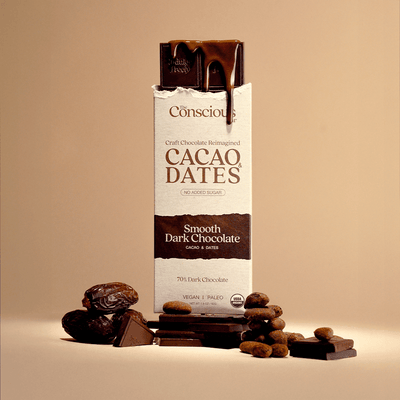
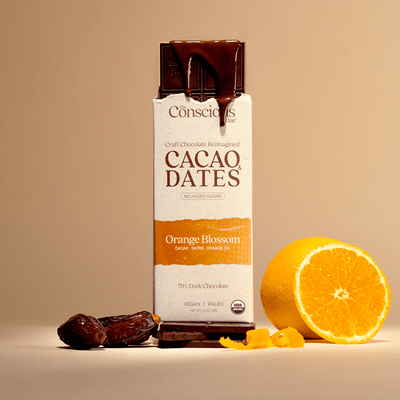
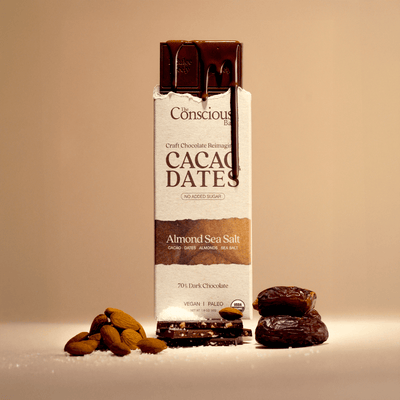
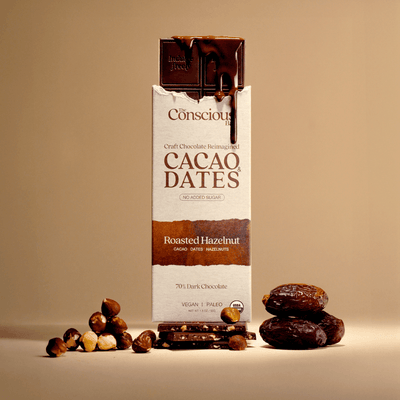
Whole dates: fiber intact (approximately 6.7g per 100g). Research has measured the glycemic index of Medjool dates at approximately 42–62 depending on variety and ripeness placing them in the low-to-moderate range. The fiber present in the whole fruit actively slows absorption, contributing to a more gradual blood sugar response compared to refined sugar.
Dates also retain their original potassium, magnesium, and polyphenols, compounds that are lost in the refining process. These are present not because they were added, but because nothing was removed.
Four Practical Tips for Managing the Cycle
The crash cycle is predictable, which means it is also manageable.
1. Choose sweeteners that come with their fiber
Whole-food sweeteners retain their original fiber.
Isolated sweeteners and added sugars do not.
The fiber is what slows the absorption.
2. Eat more slowly
Research has associated faster eating with larger postprandial blood sugar spikes.
Slowing down gives the digestive system more time to process glucose gradually.
3. Pair sweet foods with fat or protein
Both fat and protein slow gastric emptying independently of fiber.
A square of dark chocolate (which contains both fat and fiber) behaves differently in the body than a refined sugar snack, even at similar calorie counts.
4. Move lightly after meals
Light physical activity starting around 15–45 minutes after eating coincides with the window when blood glucose is peaking.
Even a short walk can help muscles pull glucose from the blood, reducing the height of the spike.
Sources
- Glucose Variability and Oxidative Stress — ClinicalTrials.gov
- Blood Sugar Spike and Crash Mechanism — PMC
- Refined Carbohydrates and Blood Sugar — PMC
- Soluble Dietary Fiber and Glycemic Response — PMC
- Fiber Meta-analysis — PMC
- Glycemic Index of Dates — AlGeffari et al., Annals of Saudi Medicine, 2016
- Nutritional Profile of Dates — PMC
- Eating Speed and Blood Sugar — GoodRx Health
- Medjool date fiber content
- Post-meal movement