Chocolate Isn’t Just About Taste
It’s About Digestion.
When most people think about chocolate, they think about flavor. But what matters just as much, if not more, is how your body processes it.
Because not all chocolate is digested the same way. And the difference often comes down to one overlooked factor:
Fiber.
The Problem With Most Chocolate
Most conventional chocolate is designed for taste and shelf life, not digestion.
It’s typically:
- High in refined sugar
- Lower in cacao
- Low in fiber
This creates a predictable effect:
- Sugar is rapidly absorbed
- Blood glucose spikes
- Insulin follows
- Energy drops shortly after
That’s the classic “sugar high → crash” cycle.
What Fiber Does Differently
Fiber changes this entire process.
Not by adding sweetness, but by changing how your body handles what you eat.
1. Fiber Slows Sugar Absorption
Soluble fiber forms a gel-like structure during digestion. This slows the movement of food through your gut and delays how quickly sugar enters your bloodstream.
The result:
- More gradual glucose response
- Fewer sharp spikes
- Less dramatic crashes
2. Fiber Acts as a Prebiotic
Your body doesn’t digest fiber, but your gut bacteria do.
Cacao fiber feeds beneficial microbes like:
- Bifidobacterium
- Lactobacilli
These bacteria play a key role in:
- Digestion
- Immune function
- Metabolic health
3. Fiber Unlocks Hidden Compounds in Cacao
Cacao is rich in polyphenols, powerful antioxidant compounds. But many of these are too large to be absorbed in the small intestine.
Fiber helps carry them into the colon, where gut bacteria break them down into smaller, bioavailable compounds.
In other words: Fiber helps you actually access more of cacao’s benefits.
4. Fermentation Creates Beneficial Byproducts
When gut bacteria ferment cacao fiber, they produce short-chain fatty acids (SCFAs) like:
- Butyrate
- Propionate
These compounds are linked to:
- Reduced inflammation
- Gut lining support
- Improved metabolic function
5. Fiber Improves Satiety
High-fiber foods slow stomach emptying.
This helps you:
-
Feel fuller longer
-
Reduce cravings
-
Avoid overeating
Which is why some chocolate feels “never enough”…while others actually satisfy.
Why Cocoa Percentage Matters
Not all chocolate contains meaningful fiber.
Higher cacao chocolate (70%+):
- Contains significantly more fiber
- Has fewer added sugars
- Delivers a more balanced metabolic response
Lower cacao chocolate:
- Prioritizes sweetness
- Reduces fiber content
- Increases likelihood of spikes and crashes
The Takeaway
The difference between chocolate that feels good in the moment …and chocolate that feels good after.
Often comes down to fiber.
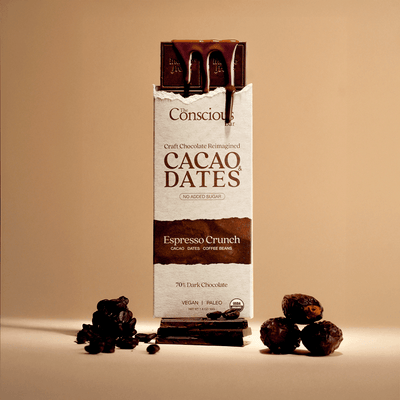
Where The Conscious Bar Fits In
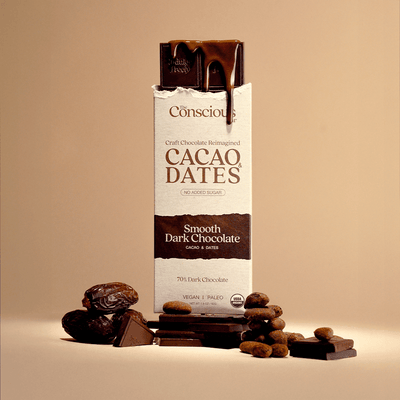
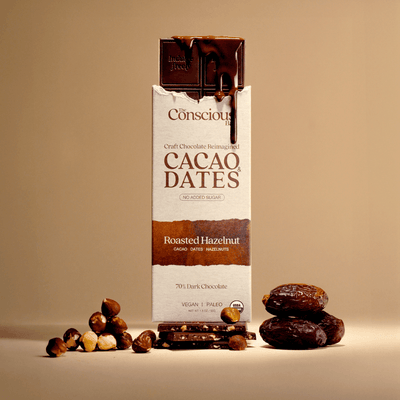
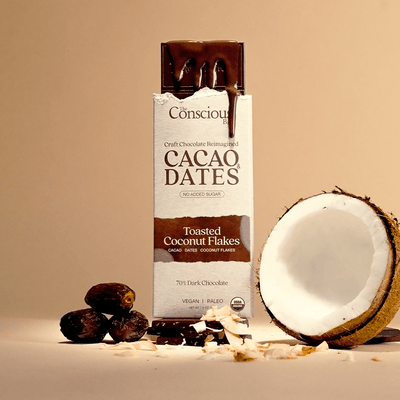
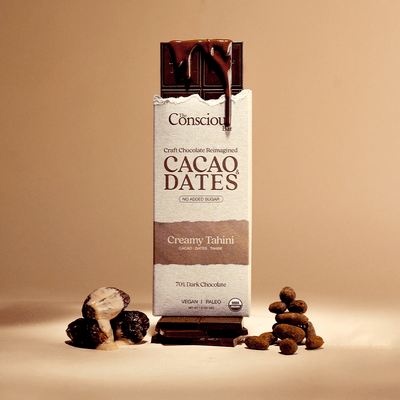
At The Conscious Bar, we don’t remove what matters.
We keep it simple:
- Organic cacao
- Organic dates
That means:
- Naturally occurring fiber
- No refined sugar
- A more balanced experience
Final Thought
Chocolate doesn’t have to be something you recover from.
When made differently, it becomes something your body actually works with, not against.
Sources:
- https://diabetesfoodhub.org/blog/can-people-diabetes-eat-chocolate#:~:text=To%20enjoy%20chocolate%20while%20managing,choice%20for%20people%20with%20diabetes.
- https://www.health.com/healthy-dark-chocolate-11889844#:~:text=The%20higher%20the%20cocoa%20percentage,magnesium%20are%20in%20the%20bar.
- https://www.theguardian.com/food/2023/feb/19/notes-on-chocolate-who-knew-about-fibre-in-chocolate#:~:text=Maybe%20it%20was%20because%20I,%25%20fibre%2C%20which%20is%20high.
- https://pmc.ncbi.nlm.nih.gov/articles/PMC4696435/