You probably already know that what you eat affects how you feel. But the science behind why is more fascinating than most people realize.
Your gut and your brain are connected through a two-way communication system. A constant exchange of signals that shapes everything from digestion to mood to cognition.
This system is known as the gut-brain axis.
And it's one of the most studied areas of nutrition science today.
How the Gut-Brain Axis Actually Works
The gut-brain axis runs on three main communication channels:
- The vagus nerve: a long nerve that connects your digestive tract directly to your brain and sends signals in both directions
- The immune system: which responds to what happens in the gut and sends messages throughout the body
- Gut microbiome chemistry: the trillions of bacteria in your digestive tract produce compounds that can influence inflammation, neurotransmitters, and brain signaling
Together, these channels mean your gut isn't just processing food. It's actively shaping your internal environment… including how your brain functions.
Why Cacao Is Part of the Conversation
Cacao contains a class of plant compounds called polyphenols, and specifically, a subgroup called flavanols. These flavanols have an unusual trait: most of them are not fully absorbed in the small intestine.
At first, that sounds like a downside. But it's actually what makes cacao so interesting for gut health.
Because the flavanols aren't absorbed early, they travel further down the digestive tract and reach the colon, where your gut microbes break them down into smaller, bioactive compounds.
In that sense, cacao flavanols act in a prebiotic-like way, helping shift the balance of gut bacteria and supporting the production of metabolites that may benefit the body and brain.
Cacao and Microbiome Diversity
Research suggests that cocoa polyphenols may:
- Increase beneficial microbial diversity
- Shift the balance of gut bacteria in favorable ways
- Support healthier gut-barrier function
- Reduce inflammatory signaling in certain contexts
Why does this matter? Because a more diverse, balanced microbiome is often associated with better overall gut ecology and that connects directly back to brain health through the axis.
What this means: the better the ecosystem in your gut, the clearer the conversation with your brain.
Cacao and Mood
The connection between cacao and mood is promising, but worth framing honestly.
In one small human study, participants who consumed 85% cocoa dark chocolate experienced increased microbial diversity and reported changes in negative mood states. Researchers suggested this pointed to a possible gut-brain link.
However, the study was small and doesn't prove that cacao alone caused the mood shift.
The best-supported view is this: cacao may support mood indirectly, by nudging the microbiome in a favorable direction not by acting as a treatment for depression, anxiety, or any clinical condition.
What this means: cacao isn't a mood cure. But it may play a small, supportive role as part of a broader gut-healthy pattern of eating.
Cacao and Cognition
Cocoa flavanols may also support cognition, and there are two main theories for why:
- They help gut microbes produce active metabolites that can influence brain signaling
- They may improve blood flow and vascular function, including in the brain
Reviews of the research have found possible benefits for attention, memory, and other cognitive domains, especially among some older adults.
That said, results are not uniform across studies, and the size of the effect is typically modest.
What this means: cacao may offer a small cognitive benefit but it's not a guaranteed memory booster, and the effects vary from person to person.
The Bigger Picture: Cacao in Context
The strongest takeaway from the research is this:
Cacao's polyphenols interact meaningfully with your gut microbes. That interaction may influence mood and cognition through the gut-brain axis. But the leap from biologically plausible to reliably life-changing is still being studied.
In practical terms:
- Cacao works best as part of a pattern, not as a single solution
- Pair it with fiber, plants, and fermented foods for the most supportive effect
- Choose minimally processed cacao because the surrounding ingredients matter
- Don't expect miracles expect gentle, cumulative support
Why the Ingredients Around Cacao Matter
Here's a detail that often gets missed in wellness conversations: the environment cacao lands in inside your body matters.
Most mainstream chocolate contains:
- Refined sugar
- Industrial seed oils
- Emulsifiers and additives
These ingredients don't erase cacao's compounds but they can oppose the potential benefits by feeding the less favorable side of your microbiome or adding inflammatory signals of their own.
So when researchers talk about the benefits of cacao, they're typically referring to minimally processed cocoa — not the version that comes with 15 grams of added sugar per serving.
The cleaner the formulation, the cleaner the signal.
The Takeaway
The gut-brain axis is real, and it's one of the most exciting frontiers in nutrition science.
Cacao has earned its place in that conversation not as a magical cure, but as a food whose compounds interact with the microbiome in meaningful ways.
If you're going to eat chocolate (and you should, life is too short not to), choose the kind that actually lets cacao do its job.
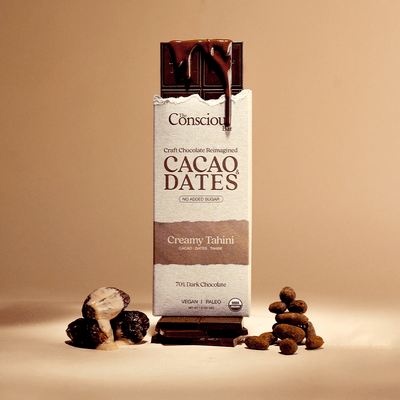
That's the whole reason dark chocolate, 70%+ cacao, keeps showing up in gut-health research. And it's why we built our bars around just two superfoods, organic cacao and organic dates, with no refined sugar, no oils, and no fillers.
Nothing to oppose the conversation your gut and brain are already having.
Try it now
Sources:
- Mental Health America — The Gut-Brain Connection
- BrainFacts — The Gut and the Brain: A Surprising Connection
- NIH PMC — Cocoa Polyphenols and the Gut Microbiome
- PubMed — Cocoa Flavanols and Cognitive Function
- NIH PMC — Dark Chocolate and Microbial Diversity
- NIH PMC — Polyphenols, Gut Microbiota, and Health
- ScienceDirect — Cocoa, Gut Microbiota and Neurocognitive Function