The Problem Was Never Chocolate.
Chocolate has a reputation problem.
It’s one of the most craved foods on the planet, and one of the most misunderstood.
People blame chocolate for sugar crashes, weight gain, and unhealthy cravings. But when you look at what’s actually inside most chocolate bars, the problem becomes obvious.
It’s not the chocolate. It’s the sugar.
Cacao — the raw seed at the heart of every chocolate bar — is one of the most nutrient-dense foods in nature. It’s packed with flavonoids, magnesium, iron, and fiber.
But somewhere along the way, chocolate stopped being about the cacao. Sugar took over. And most of us never noticed.
How Sugar Became Chocolate’s Main Ingredient
Making real chocolate from quality cacao is expensive. Cacao beans are labor-intensive to grow, harvest, ferment, and process. And high-quality cacao costs significantly more per pound than sugar.
So as the chocolate industry scaled up over the 20th century, manufacturers found a simple shortcut: use less cacao and more sugar. Sugar is roughly ten times cheaper than cacao, so increasing the sugar ratio dramatically reduced production costs while keeping the product sweet and palatable.
The result? Many of the most popular chocolate bars on shelves today are over 50% sugar by weight. Some mass-market milk chocolate bars contain as little as 11% cacao, meaning the rest is sugar, milk powder, emulsifiers, and fillers.
When sugar is the first ingredient on the label, what you’re eating is confectionery, not chocolate.
A 70% dark chocolate bar, by contrast, contains about 30% non-cacao ingredients (mostly sugar). But even within the dark chocolate category, the type and quality of that remaining 30% matters enormously.
What Added Sugar Actually Does to Your Body
The health implications of added sugar go well beyond empty calories. Research from some of the most respected institutions in the world has connected excessive added sugar intake to a range of serious health concerns.
Heart Disease
A major 15-year study published in JAMA Internal Medicine found that people who consumed 25% or more of their daily calories from added sugar were more than twice as likely to die from cardiovascular disease compared to those consuming less than 10%. That risk held true regardless of age, sex, physical activity level, or body weight. (Yang et al., JAMA Internal Medicine, 2014)
Inflammation and Metabolic Disruption
Harvard Medical School researchers have found that high sugar intake may raise blood pressure, increase chronic inflammation, and overload the liver, which converts excess sugar into fat. Over time, this can contribute to fatty liver disease, insulin resistance, and elevated triglycerides. (Harvard Health Publishing)
Blood Sugar Spikes and Crashes
Foods high in refined sugar cause rapid spikes in blood glucose, followed by sharp crashes. This cycle can lead to fatigue, brain fog, mood swings, and increased cravings, which often leads to eating more sugar. It’s a loop that feeds itself.
Dopamine and Overconsumption
Sugar activates the brain’s dopamine reward pathways in a way that can drive repeated overconsumption. When combined with the naturally stimulating compounds in chocolate (theobromine and caffeine), this creates what food scientists call a “bliss point”; a formulation optimized for craving, not nutrition.
The takeaway: added sugar doesn’t just add calories. It can actively work against your health when consumed in excess.
Meanwhile, Cacao Is One of Nature’s Most Powerful Foods
Here’s where the story gets interesting. The very ingredient that sugar has been overshadowing, cacao, is actually a nutritional powerhouse.
Cacao beans are one of the richest natural sources of flavonoids, a class of plant compounds with strong antioxidant and anti-inflammatory properties. The primary flavonoid in cacao, epicatechin, has been the subject of extensive clinical research.
What the science shows:
- Cacao flavanols may help support healthy blood pressure. A Cochrane Database review of randomized controlled trials confirmed a modest blood-pressure-lowering effect from cocoa consumption. (Ried et al., Cochrane Database, 2017)
- Cacao flavanols can improve blood vessel function. A UCSF clinical trial found that daily consumption of flavonoid-rich dark chocolate improved brachial artery dilation, an indicator of cardiovascular health, over a two-week period. (Engler et al., Journal of the American College of Nutrition, 2004)
- Cacao flavanols may support brain health. A study published in Scientific Reports found that dietary flavanols improved cerebral cortical oxygenation and cognitive performance in healthy adults, particularly during complex tasks. (Rendeiro et al., Scientific Reports, 2020)
- The FDA authorized a qualified health claim in 2023 for high-flavanol cocoa powder, acknowledging the growing evidence linking cocoa flavanols to reduced cardiovascular disease risk.
Cacao also naturally contains magnesium, iron, potassium, and dietary fiber, nutrients that support everything from energy and muscle function to digestive health.
In other words, cacao was never the problem. It was always the good guy.
When Sugar Works Against Cacao’s Benefits
This is the part that matters most for anyone who loves chocolate and cares about what they’re putting in their body.
When you load a chocolate bar with refined sugar, you don’t just dilute the cacao, you introduce an ingredient that can work against the very benefits cacao provides.
Research suggests that excessive sugar can trigger insulin spikes, promote inflammation, and contribute to oxidative stress, all processes that oppose the antioxidant and anti-inflammatory effects of cacao’s flavonoids.
It’s not that sugar “destroys” cacao’s benefits in some dramatic way. It’s more like this: you’re eating something that can support your cardiovascular system and brain health, while simultaneously eating something that may undermine those same systems.
The purpose of eating something healthy is defeated when the other ingredients are actively working against it.
How to Find Chocolate That’s Actually Working for You
You don’t have to give up chocolate. You just have to choose it more carefully.
Here’s what to look for:
- Check the first ingredient: If sugar is listed first, the bar contains more sugar than cacao. That’s confectionery, not chocolate.
- Look for 70% cacao or higher: Higher cacao percentage generally means more flavonoids and less sugar. But percentages alone don’t tell the full story, the type of sweetener and the overall ingredient list matter too.
- Read the full ingredient list: The shorter the list, the better. Ingredients you recognize as real foods are a strong signal. If the list includes emulsifiers, industrial fillers, or refined sugars, that’s worth noticing.
- Consider what the sweetener actually is: Not all sweeteners are the same. A whole-food sweetener that retains its fiber, minerals, and nutritional structure behaves very differently in the body than an isolated, refined sugar.
- Pair it with fiber when you can: Eating chocolate alongside or as part of a fiber-rich meal may help stabilize your blood sugar response. Some chocolates already contain fiber from their ingredients (i.e dates), which can support a steadier energy release.
The Bottom Line
Chocolate isn’t the villain. Sugar is.
For decades, the chocolate industry has leaned on sugar to cut costs, mask low-quality cacao, and engineer cravings. The result is a product that looks like chocolate, tastes sweet, and delivers very little of what cacao actually has to offer.
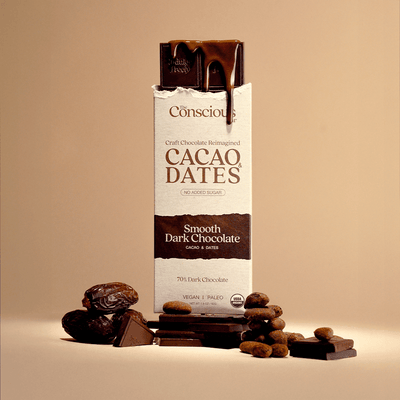
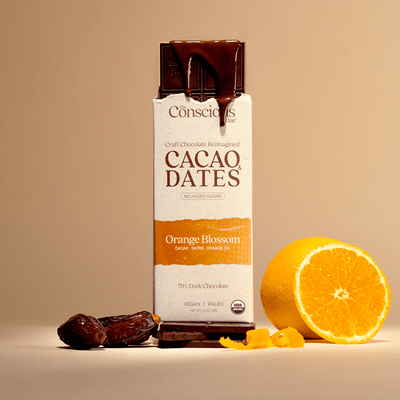
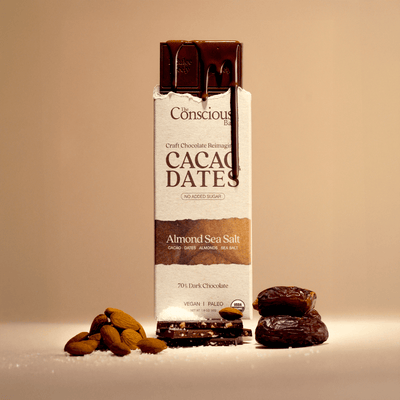
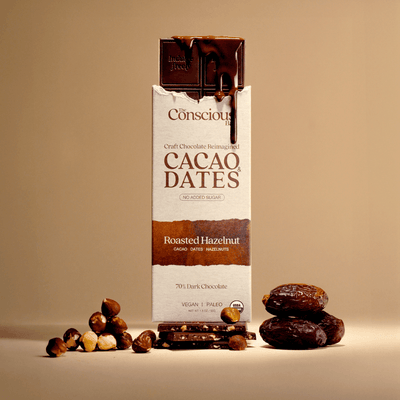
But when chocolate is made the right way, with real cacao at the center and a whole-food sweetener that doesn’t fight against the benefits, it becomes something else entirely.
It becomes chocolate that’s actually working for you. Rich, fudgy, decadent, and full of the nutrients cacao was always meant to deliver.
That’s what chocolate should be.
Sources
- Yang Q, et al. “Added Sugar Intake and Cardiovascular Diseases Mortality Among US Adults.” JAMA Internal Medicine, 2014. https://pmc.ncbi.nlm.nih.gov/articles/PMC10910551/
- Harvard Health Publishing. “The Sweet Danger of Sugar.” Harvard Medical School. https://www.health.harvard.edu/heart-health/the-sweet-danger-of-sugar
- Ried K, Fakler P, Stocks NP. “Effect of Cocoa on Blood Pressure.” Cochrane Database of Systematic Reviews, 2017. https://pubmed.ncbi.nlm.nih.gov/28439881/
- Engler MB, et al. “Flavonoid-Rich Dark Chocolate Improves Endothelial Function.” Journal of the American College of Nutrition, 2004. UCSF. https://www.ucsf.edu/news/2004/06/97605/small-daily-doses-flavonoid-rich-chocolate-improve-blood-vessel-function-study
- Rendeiro C, et al. “Dietary Flavanols Improve Cerebral Cortical Oxygenation and Cognition in Healthy Adults.” Scientific Reports, 2020. https://www.nature.com/articles/s41598-020-76160-9
- FDA Qualified Health Claim for High Flavanol Cocoa Powder, February 2023. https://www.npr.org/sections/health-shots/2023/02/12/1156044919/chocolate-heart-health-flavanols
- Katz DL, Doughty K, Ali A. “Cocoa and Chocolate in Human Health and Disease.” Antioxidants & Redox Signaling, 2011. https://pmc.ncbi.nlm.nih.gov/articles/PMC4696435/