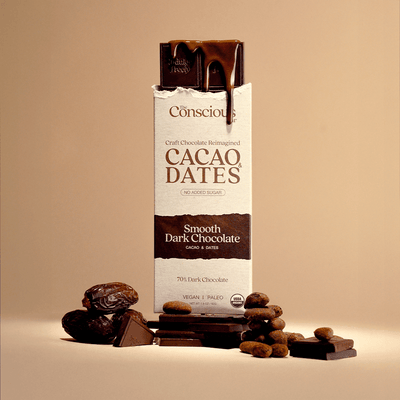
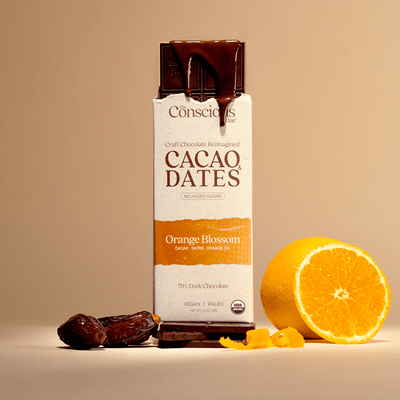
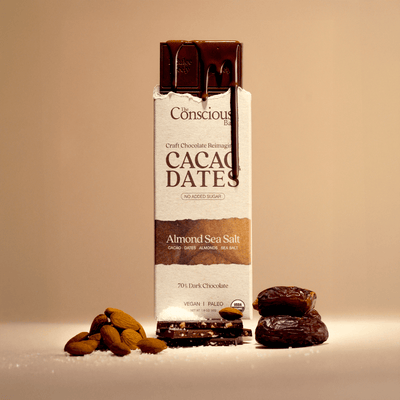
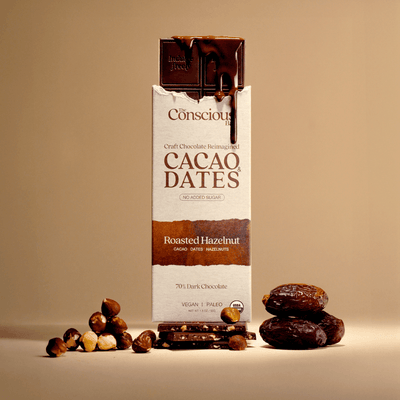
Spend five minutes in any health food aisle and you’ll notice something. Chocolate has rebranded.
The same product that used to sit next to candy bars is now draped in forest-green packaging, stamped with words like “guilty-free,” and positioned alongside protein powders and adaptogens.
Some of it is genuinely better. A lot of it isn’t.
Here’s what’s actually happening in the “healthy chocolate” space and how to tell the difference.
What Is the Health Halo Effect?
The health halo effect is a well-documented psychological phenomenon: when a product makes a single positive health claim, we tend to assume the whole product is healthier than it actually is.
Food brands know this. It’s not a secret.
When a chocolate bar says “no added sugar” on the front, or features the word “organic” in large type, most shoppers give the rest of the ingredient list significantly less scrutiny than they otherwise would.
The result: bars with lengthy ingredient lists, processed sweeteners, and industrial emulsifiers get sold alongside genuinely clean products, at similar prices, with similar marketing, because the front of the package did its job.
The single most useful habit you can build when shopping for chocolate: ignore the front of the package entirely. Flip it over. Start reading from the top of the ingredient list.
Dutch Processing: The Hidden Trade-Off in Most Dark Chocolate
Cacao in its natural state is rich in flavanols, plant compounds studied in clinical trials for their potential to support cardiovascular health, improve blood flow, and reduce inflammation markers (Cochrane Review, 2012; Journal of Agricultural and Food Chemistry, 2008).
Flavanols are also intensely bitter.
To solve for that bitterness, manufacturers widely use a process called alkalization, also called Dutch processing. The cocoa is treated with an alkaline solution to raise the pH, neutralize acidity, and smooth the flavor.
It also significantly reduces the flavanol content.
A study published in the Journal of Agricultural and Food Chemistry analyzed commercial cocoa powders across different levels of processing:
|
Processing Level |
Avg. Flavanols (mg/g) |
Approx. % Retained |
|
Natural (unprocessed) |
34.6 mg/g |
100% (baseline) |
|
Lightly alkalized |
13.8 mg/g |
~40% |
|
Medium alkalized |
7.8 mg/g |
~25% |
|
Heavily alkalized |
3.9 mg/g |
~10% |
Source: Miller et al., Journal of Agricultural and Food Chemistry, 2008
Heavily Dutch-processed cocoa retains approximately 10% of the flavanols found in natural cocoa powder.
There’s also an ironic visual trick at work. Alkalization darkens the cocoa, producing a richer, deeper brown. The bars that look the most dramatically “dark” are often the most heavily processed.
What Does a Cacao Percentage Actually Tell You?
The “%” on a dark chocolate bar refers to the proportion made from cacao-derived ingredients: cocoa mass, cocoa powder, cocoa butter, or some combination.
A 72% bar means 72% cacao-derived content. It says nothing about what makes up the other 28%.
In most commercial dark chocolate, that remaining percentage is primarily refined sugar. In some formulations it also includes soy lecithin, vanillin (synthetic vanilla), and vegetable oils used to replace cocoa butter that was pressed out during manufacturing.
The cleanest signal isn’t the number on the front. It’s what follows “cacao” on the ingredient list.
How to Actually Read a Chocolate Label
A few practical things to look for:
- First ingredient should be cacao, cocoa mass, or cocoa liquor, not sugar.
- Check whether the cocoa is alkalized. Look for “processed with alkali,” “Dutch-process,” or “alkalized cocoa” in the ingredients.
- Identify the sweetener. Refined cane sugar and “sugar” are equivalent. Whole food sweeteners like dates bring fiber alongside natural sugars, which affects how the body processes them.
- Watch for emulsifiers. Soy lecithin is common. Polyglycerol polyricinoleate (PGPR) is a cheaper alternative some manufacturers use to reduce cocoa butter content.
- The shorter the ingredient list, the less there is to scrutinize.
The Bottom Line
The “healthy chocolate” category is real but it’s also noisy. The marketing language surrounding it outpaces the actual ingredient work in most cases.
Cacao does contain compounds worth caring about. The research on flavanols and antioxidant activity is credible, if modest in effect size. But those compounds survive the journey from cacao bean to finished bar only when the processing respects them.
The question worth asking isn’t “is this chocolate healthy?” It’s: what did they do to the cacao before it got to me? That answer is always in the ingredient list.
Sources
- Impact of Alkalization on Flavanol Content — Journal of Agricultural and Food Chemistry (Miller et al., 2008)
- Dutch Processing and Flavan-3-ol Stereochemistry — PMC / Journal of Agricultural and Food Chemistry (Payne et al., 2010)
- Effect of Cocoa on Blood Pressure — Cochrane Review (Ried et al., 2012)
- Health Halo and Food Label Perception — PMC / Nutrition Reviews
- What Is Alkalized Cocoa? Dutch Process Explained — ScienceInsights (2026)