Why We Started Counting
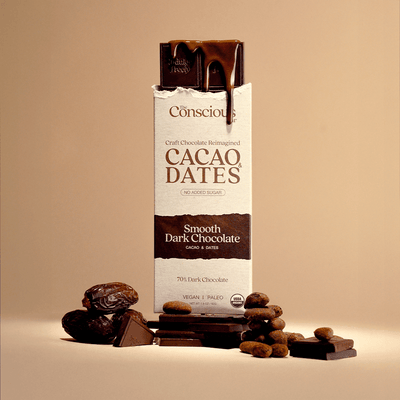
Our Smooth Dark Chocolate bar has 8 grams of fiber in every 50 gram bar, all of it from whole dates, none of it added in. You might wonder, is that actually a lot? Compared to what?
So we pulled the fiber number for every sweetener you'd normally find in a pantry, measured the same way, and lined them up side by side. Here's what we found.
What Fiber Actually Is, and Why It's Different From Sugar
Fiber and sugar are both carbohydrates, but your body treats them completely differently. Sugar gets broken down and absorbed almost immediately. That's part of why sugary foods can give you a quick burst of energy, followed by a crash.
Fiber works differently. Your body can't fully break it down. Instead, it moves through your digestive system mostly intact, doing a few important jobs along the way. Nutritionists sometimes call it roughage for exactly this reason.
There are two kinds of fiber, and most fiber-containing foods have a mix of both.
- Soluble fiber dissolves in water and forms a gel-like substance in your stomach. This slows down digestion, which is part of why it can help moderate how quickly sugar reaches your bloodstream.
- Insoluble fiber doesn't dissolve. It adds bulk and helps keep things moving through your digestive system, the way a broom keeps a floor clear.
Most whole, unprocessed foods like fruits, vegetables, and whole grains contain a mix of both types. Refined and processed foods usually contain very little of either, because the parts of the plant that carry fiber are often removed during processing.
That last sentence is the key to this whole story.
Where Every Sweetener Actually Comes From
To understand why the fiber numbers below look the way they do, it helps to know where each sweetener starts, and what happens to it before it ends up in your pantry. The short version: some of these are squeezed and refined out of a bigger plant.
Some were never anything but a sugary liquid to begin with. Only one of them is just fruit.
Table Sugar
Table sugar starts as sugarcane or sugar beets, both genuinely fibrous plants you could, in theory, chew on. To make sugar, the plant is crushed and juiced, and that juice is boiled, filtered, and crystallized again and again until only pure sucrose remains, a white crystal with no color and no flavor beyond sweetness. The fiber, along with most of the plant's other nutrients, stays behind in the leftover pulp and molasses. What's left on your shelf is essentially all sugar and nothing else.
Honey
Honey starts as flower nectar, which worker bees collect and carry back to the hive in a special stomach used just for this purpose. Once there, the bees pass the nectar between themselves, adding enzymes and evaporating most of its water content, until it thickens into the honey you recognize. Nectar itself never contained meaningful fiber to begin with. It's a sugary liquid a flower produces to attract pollinators, not a fibrous plant part like a stem or a leaf.
Maple Syrup
Maple syrup comes from the sap of maple trees, which is mostly water with a small amount of sugar dissolved in it, tapped from the trunk in early spring. To make syrup, that sap gets boiled down at a ratio of roughly forty to one, meaning it takes about forty gallons of raw sap to make a single gallon of finished syrup. Like nectar, sap is a liquid the tree produces to move sugar and nutrients from its roots to its branches. It was never a fiber source to begin with.
Coconut Sugar
Coconut sugar is made from the sap of the coconut palm's flower buds, not from the coconut fruit itself, which surprises a lot of people. Producers slice the flower stalk, collect the dripping sap in containers, and boil it down until it thickens and crystallizes into sugar granules. It's often marketed as containing more fiber and minerals than table sugar. In practice, independent testing shows the amount is small and inconsistent between batches, and the sap itself, like maple sap, starts out as a liquid rather than a fibrous plant part.
Dates, What We Use
A date doesn't go through any of that. It's not juiced, boiled down, or extracted from anything. A date palm grows clusters of fruit, and once they ripen and are harvested, a date is simply dried. That's essentially the entire process. Whatever fiber, minerals, and other nutrients were in the fruit when it was hanging on the tree are still there when it reaches you.
The Lineup, By The Numbers
Here's fiber content per 100 grams, measured the same way for each sweetener, using USDA nutrition data:
- Table sugar: 0g
- Maple syrup: 0g
- Honey: 0.2g
- Coconut sugar: essentially 0g
- Dates: 6.7g
That's not a rounding difference. Every other sweetener on this list rounds down to basically nothing. Dates are the only one that doesn't.
Why the Gap Is So Big
Notice a pattern in the sweetener origin stories above? Sugar, honey, maple syrup, and coconut sugar are all either extracted from a fibrous source and refined until the fiber is gone, or they were liquids from the very start and never had fiber to lose in the first place.
Dates are the only sweetener on this list that arrives as a whole food. Nothing gets separated out, concentrated, or filtered away. The fiber that was in the date when it was still on the tree is the same fiber that ends up in the bar.
What this means: the fiber gap isn't random. It's a direct result of how much processing each sweetener goes through to become a sweetener in the first place.
The Whole Food Idea
Nutrition researchers have a term for this: the food matrix. The idea is that nutrients in a whole food don't act alone. They work alongside the fiber, water, and structure of the food they came from, and that combination can change how your body responds to it. A sugar molecule sitting inside a date's fiber and water content behaves differently in your body than the same sugar molecule on its own in a spoonful of syrup, even though the sugar itself is chemically identical. Refining a sweetener down to pure sugar strips away that matrix entirely. Drying a date doesn't.
How Much Fiber Do You Actually Need
Most adults need somewhere between 25 and 38 grams of fiber a day, depending on age and sex. Most Americans get closer to 17 grams, which is a meaningful gap. For a sense of scale, a medium apple has about 4 grams of fiber, and a cup of cooked oatmeal has around the same. It's one reason the 8 grams in a single bar of our chocolate, all from whole dates, adds up to a real portion of your day rather than a rounding error, roughly 29 percent of the daily value in one bar.
None of this means you should try to hit your entire daily fiber target from chocolate alone. It just means the number on our label is doing real work, not sitting there as a nice-sounding footnote.
Why Fiber Actually Matters
So dates have more fiber. Why should you care? A few reasons, backed by research from places like the CDC and the National Institutes of Health.
- It helps moderate how sugar hits your system. Soluble fiber forms a gel-like substance as it moves through your stomach, which slows down digestion. That means the sugar naturally present in a fiber-rich food tends to reach your bloodstream more gradually, instead of all at once the way sugar on its own does.
- It feeds your gut bacteria. Your body can't fully digest fiber, but the bacteria living in your gut can. When they break it down, they produce compounds called short-chain fatty acids, which research links to lower inflammation and better metabolic health.
- It helps you feel full. Soluble fiber adds bulk and slows digestion, which is part of why fiber-rich foods tend to be more satisfying than the same amount of sugar on its own.
- It supports heart health. Some of the short-chain fatty acids fiber produces during digestion are linked to healthier cholesterol levels over time.
A Quick Example
Picture two spoonfuls sitting side by side. One is honey, straight from the jar. The other is a chopped up date. Both taste sweet. Both contain natural sugar. But the honey is pure liquid sugar with nothing else to slow it down. The date carries roughly seven percent of its weight in fiber, plus a source of potassium and iron, all wrapped inside the same bite of sweetness. Your body processes those two spoonfuls differently, even though your tongue registers them as similarly sweet.
Common Questions
Is dried fruit sugar still just sugar?
Dried fruit does concentrate the natural sugar in a fruit, since removing the water leaves more sugar per bite than the fresh version has. But drying doesn't remove the fiber. Ounce for ounce, a date still carries its fiber content along with its sugar, unlike a sweetener that was refined down to sugar and nothing else.
How does this compare to eating a fresh piece of fruit, like an apple?
Fairly similarly, actually. An apple and a date are both whole fruits, and both keep their fiber intact. The main difference is water content. A fresh apple is mostly water, so its sugar and fiber are more diluted per bite. A dried date has had most of its water removed, so both its sugar and its fiber end up more concentrated.
Does the fiber survive the chocolate-making process?
Yes. Making our bar means combining organic cacao, organic dates, and organic cacao butter, then setting that mixture into a bar. Nothing gets boiled down, juiced, or filtered out along the way, so the dates keep the same fiber they had going in.
What about the claims that coconut sugar has more minerals than table sugar?
You'll see that claim around, and it traces back to one study of a specific batch that later research hasn't been able to consistently reproduce. We'd rather leave a claim on the table than repeat one we can't fully stand behind. What's easy to verify is the fiber number, which for coconut sugar rounds down to essentially zero either way.
Why use dates instead of regular sugar in the first place?
Cacao on its own is intensely bitter, so chocolate has always needed some kind of sweetener. We chose whole dates instead of refined sugar because they do the job of sweetening while bringing fiber, and a source of potassium and iron, along for the ride instead of leaving them behind.
Does This Mean Sugar, Honey, and Maple Syrup Are Bad?
No, and we're not here to tell you they are. Honey and maple syrup bring their own qualities to the table, and people have used them for a very long time, long before anyone was measuring fiber content.
What we're saying is narrower than that. If you're comparing sweeteners specifically on fiber content, the comparison isn't close. Dates are simply the whole food option on this list, and whole foods tend to keep more of what nature put into them in the first place.
Still Just Three Ingredients
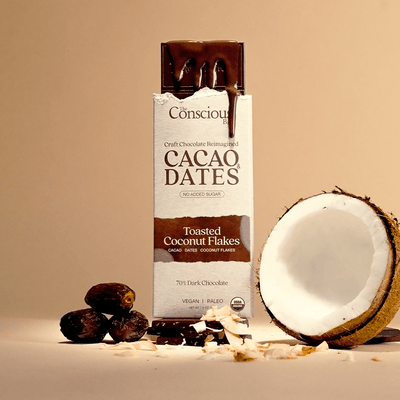
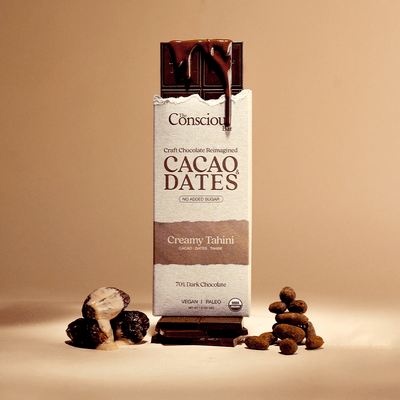
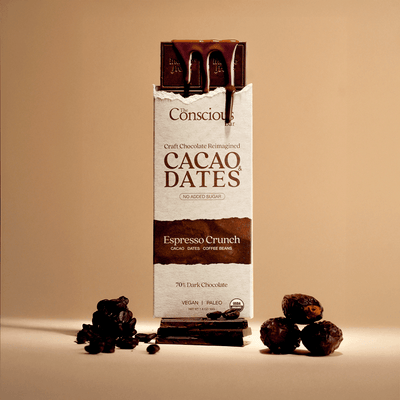
Our Smooth Dark Chocolate is organic cacao, organic dates, and organic cacao butter. That's the entire ingredient list. The 8 grams of fiber in every 50 gram bar comes from the same whole, dried dates you can see in our photos, not a fiber powder or syrup added back in after the fact.
We didn't set out to win a fiber comparison. We just never took anything out of the fruit to begin with.
_________
Sources
- Fiber: The Carb That Helps You Manage Diabetes, CDC
- The Role of Dietary Fiber in Health Promotion and Disease Prevention, StatPearls / NCBI Bookshelf
- USDA FoodData Central
- Coconut Sugar: Chemical Analysis and Nutritional Profile, Health Impacts, Safety and Quality Control, Food Industry Applications (MC)